AI Just Rewrote the Rules of Getting Found Online — And Most Owners Haven't Noticed Yet
Search is shifting from a list of blue links to a single AI answer. Here's what GEO (Generative Engine Optimization) means for Jacksonville businesses, what's at stake, and what to do before your competitors figure it out.
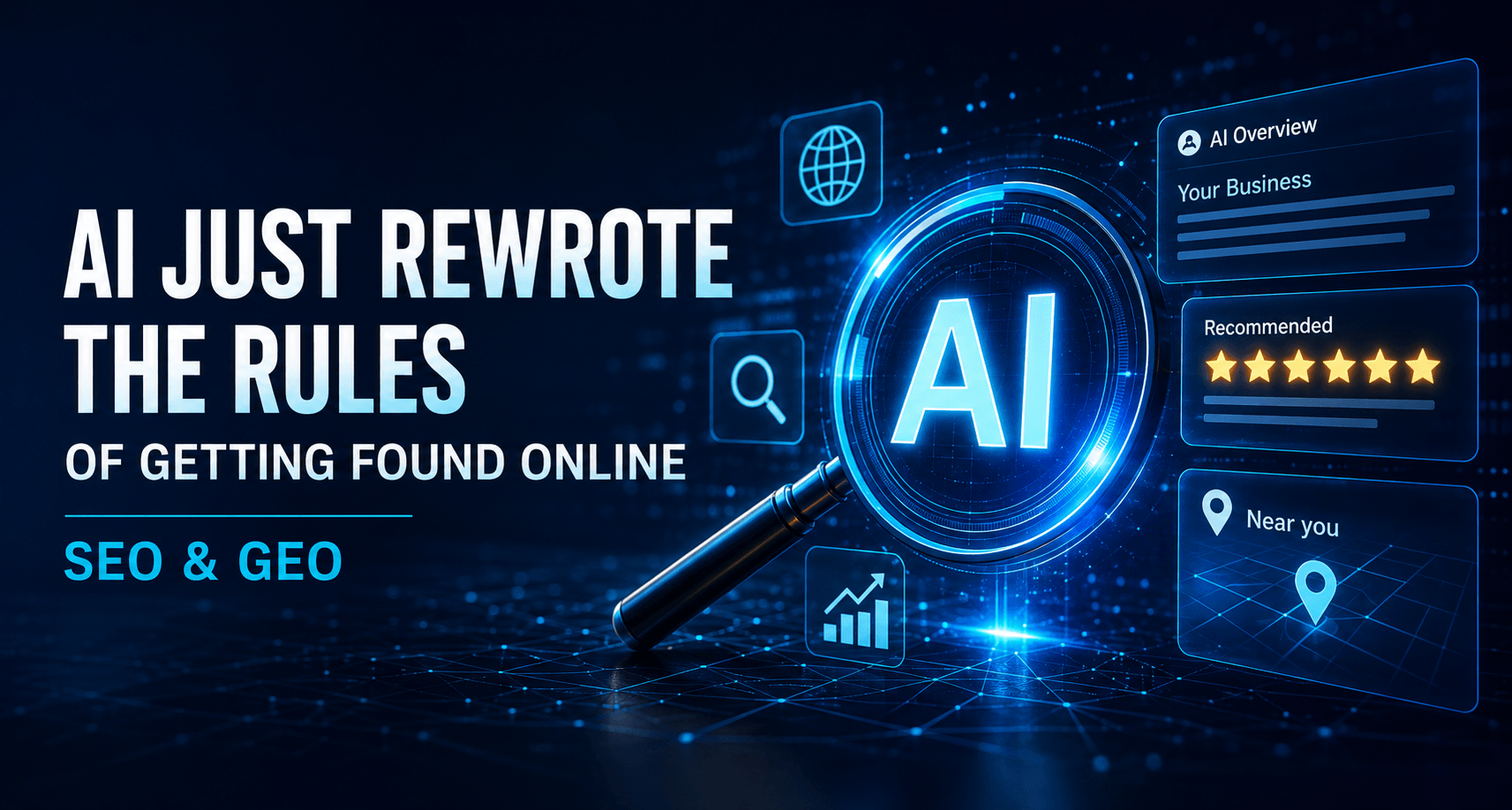
For twenty years, getting found online meant one thing: show up on the first page of Google. You typed in a search, you got a list of blue links, and the businesses at the top got the clicks. Whole industries were built around climbing that list. It was simple, and most business owners understood the game even if they didn't play it well.
That game is quietly ending. And most owners haven't noticed — which is exactly why the ones who do notice have a rare window right now.
What's actually changing
More and more, people don't scroll through ten links anymore. They ask a question and get a single answer. Google now puts an AI-generated summary at the top of many searches. Millions of people ask ChatGPT, Gemini, or Perplexity for recommendations directly — "who's a good managed IT company in Jacksonville?" — and get back a short, confident answer naming a few businesses.
Here's the shift that matters: the AI picks who gets mentioned, and the customer often never sees a list at all. If your business is the one named in that answer, you win the customer before a competitor is even considered. If you're not named, you're invisible — not on page two, just gone. There's no second page in an AI answer.
Why this matters more than the old rules
The old world had a consolation prize. Even if you weren't #1, you might be #4, and some people scrolled. The new world is closer to winner-take-most. When someone asks an AI for "the best IT provider near me," it typically names a small handful. Being the seventh-best option used to still get you some traffic. Now it often gets you nothing.
That's the risk. But it's also the opportunity — because this is new. Most of your competitors are still optimizing for a version of search that's fading, or they're not thinking about it at all. The businesses that understand how AI chooses who to recommend can get named in those answers now, while the field is wide open, and lock in that position before everyone else catches up.
SEO and GEO — what's the difference?
You've probably heard of SEO, Search Engine Optimization — the practice of making your website rank in traditional search results. It still matters. But there's a newer discipline layered on top of it: GEO, or Generative Engine Optimization — making sure AI systems can find, understand, trust, and cite your business when they answer questions.
They overlap, but they're not the same. SEO is about ranking a page. GEO is about being the answer. And what earns an AI's trust is a little different from what earns a top-ten ranking.
What actually gets your business recommended by AI
You don't need to become a technical expert. But it helps to know what these systems reward, because it's mostly things a good business already has — just made visible and machine-readable:
- Clear, factual content that answers real questions. AI pulls from pages that explain things directly. Marketing fluff doesn't get cited; a straight answer to "how much does managed IT cost in Jacksonville?" does.
- A consistent, verifiable identity. Your business name, address, and phone number matching everywhere online, a complete Google Business Profile, and real reviews all tell AI you're a legitimate, established entity worth naming.
- Third-party proof. AI weighs what others say about you — reviews, directories, mentions — heavily. It's the digital version of word of mouth.
- Structure it can read. Behind the scenes, there's markup that tells AI exactly what your business does, where, and for whom. Most small-business websites don't have it. That's an easy edge.
What to do now
Start with the free, high-impact basics: claim and fully complete your Google Business Profile, get consistent reviews from happy customers, and make sure your business details are identical everywhere they appear online. Then look at your website — does it plainly answer the questions your customers actually ask, or is it a brochure? The brochure era is over.
Then get a professional to look at the technical side — the structured data and content signals that determine whether AI can confidently recommend you. This is precisely the kind of work that's invisible to you but decisive to a machine.
The window is open — for now
Every major shift in how customers find businesses has created winners and losers. The winners weren't the biggest companies. They were the ones who moved while everyone else was still doing it the old way. AI-driven search is that shift, happening right now, and the field in Jacksonville is still wide open.
Want to know whether AI systems can find and recommend your business today — and what it would take to make sure they do? Book a call with CyberTech and we'll show you where you stand and where the fastest wins are.
Questions about your own setup?
Talk to a real CyberTech engineer — no call center, no obligation.