It's Not If the Storm Comes — It's Whether Your Business Comes Back
In Jacksonville, disaster recovery isn't theoretical — it's hurricane season. Here's the plain-English difference between backing up your data and actually being able to recover your business, and how to know which one you really have.
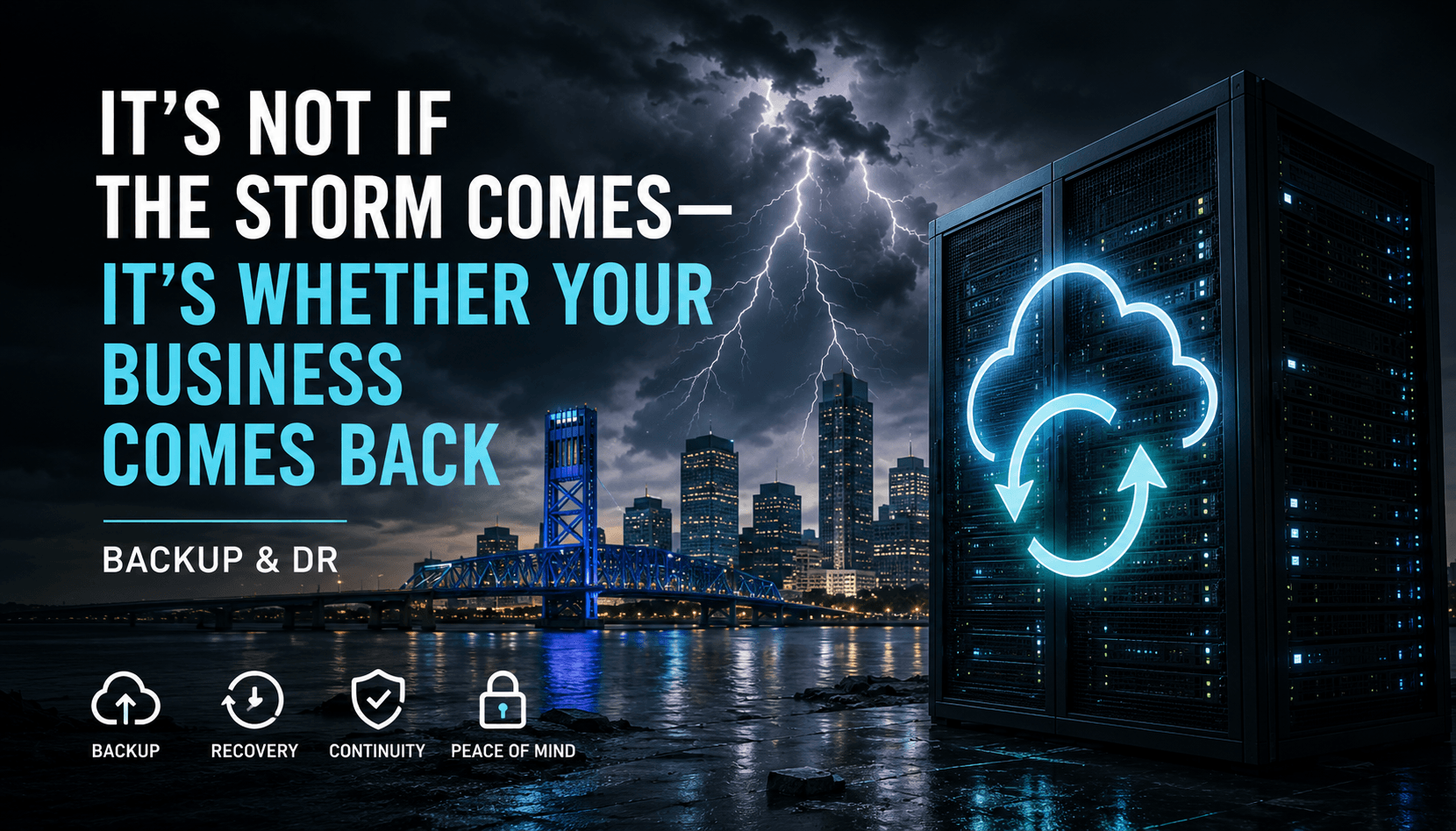
Every business owner in Jacksonville knows the drill. The cone appears on the news, the shelves at the store empty out, and you spend a few days hoping the storm turns. We plan for our homes, our families, and our physical stores. But there's one question most owners can't answer honestly: if a storm — or a flood, a fire, or a failed server — took out your systems tomorrow, how long until your business is actually running again?
For a lot of businesses, the honest answer is "we're not sure," and that uncertainty is the whole problem. Here on the First Coast, disaster recovery isn't a hypothetical you can put off. It's a line item on the calendar every June.
"We have backups" is not a recovery plan
Here's the most expensive misunderstanding in small business technology: assuming that because your data is backed up, your business is protected. Those are two very different things.
A backup is a copy of your data. Recovery is getting your business operational again — your systems running, your team working, your customers served. You can have perfect backups and still be down for a week, because nobody ever tested how long it actually takes to restore everything and turn it back on. The backup is the ingredient. Recovery is the meal. Most businesses have never checked whether they can actually cook.
The questions that reveal the truth
You don't need to be technical to pressure-test your own readiness. Ask whoever handles your IT these five questions, and listen for confident, specific answers:
- How recent is our most recent backup? If a storm hit right now, would we lose an hour of work, or a week?
- Where is that backup? If it's a drive in the same building as the servers, a flood or fire takes both. Backups need to live somewhere the disaster can't reach — the cloud, or another location entirely.
- Have we ever actually restored from it? An untested backup is a guess. Plenty of businesses discover their backups were silently failing only when they finally need them.
- How long would full recovery take? Hours? Days? Do we even know? That number is the difference between an inconvenience and a catastrophe.
- What does a day of downtime cost us? Lost sales, idle payroll, missed commitments, reputation. Once you know that number, the value of being able to recover fast becomes obvious.
If the answers are vague, that's not a knock on your team — it's a signal that "backups" were set up once and never truly stress-tested. Which is exactly the situation you don't want to discover during a named storm.
What real disaster recovery looks like
A genuine recovery plan is straightforward when someone builds it deliberately:
- Backups that are automatic, frequent, and off-site — so a local disaster can't take both your systems and your safety net at once.
- Backups that are tested on a schedule — because the only backup that counts is one you've proven can be restored.
- A written recovery plan — who does what, in what order, so recovery isn't improvised while everyone's stressed and the power's out.
- A realistic recovery time you actually know — a number you've measured, not hoped for, so you can plan the business around it.
None of this is exotic. It's the difference between a business that treats a disaster as a bad few days and one that treats it as an existential event.
The Jacksonville reality
We don't get to pretend hurricanes are somebody else's problem. Beyond the weather, the everyday disasters — a failed hard drive, ransomware, an accidental deletion, a fried server after a power surge — hit businesses here just like everywhere else. The storm season simply makes the stakes impossible to ignore.
The businesses that bounce back fastest aren't lucky. They decided, before the storm, that "we'll figure it out if it happens" wasn't good enough. They put a real plan in place while the skies were clear — which is the only time you can.
Don't wait for the cone
The worst time to discover your backups don't work is the day you need them. The best time to find out is a quiet afternoon like today, before the next system on the news.
Let's make sure your business can actually come back — not just that your data is copied somewhere. Book a call with CyberTech and we'll review your backup and recovery setup, test whether it truly works, and give you a straight answer on how fast you'd be back on your feet.
Questions about your own setup?
Talk to a real CyberTech engineer — no call center, no obligation.