Your Biggest Cybersecurity Risk Isn't Your Software — It's the Person Reading the Next Email
The vast majority of business breaches start with an employee clicking something they shouldn't. Here's why your team is both your weakest link and your strongest defense — and how Jacksonville owners can turn one into the other.
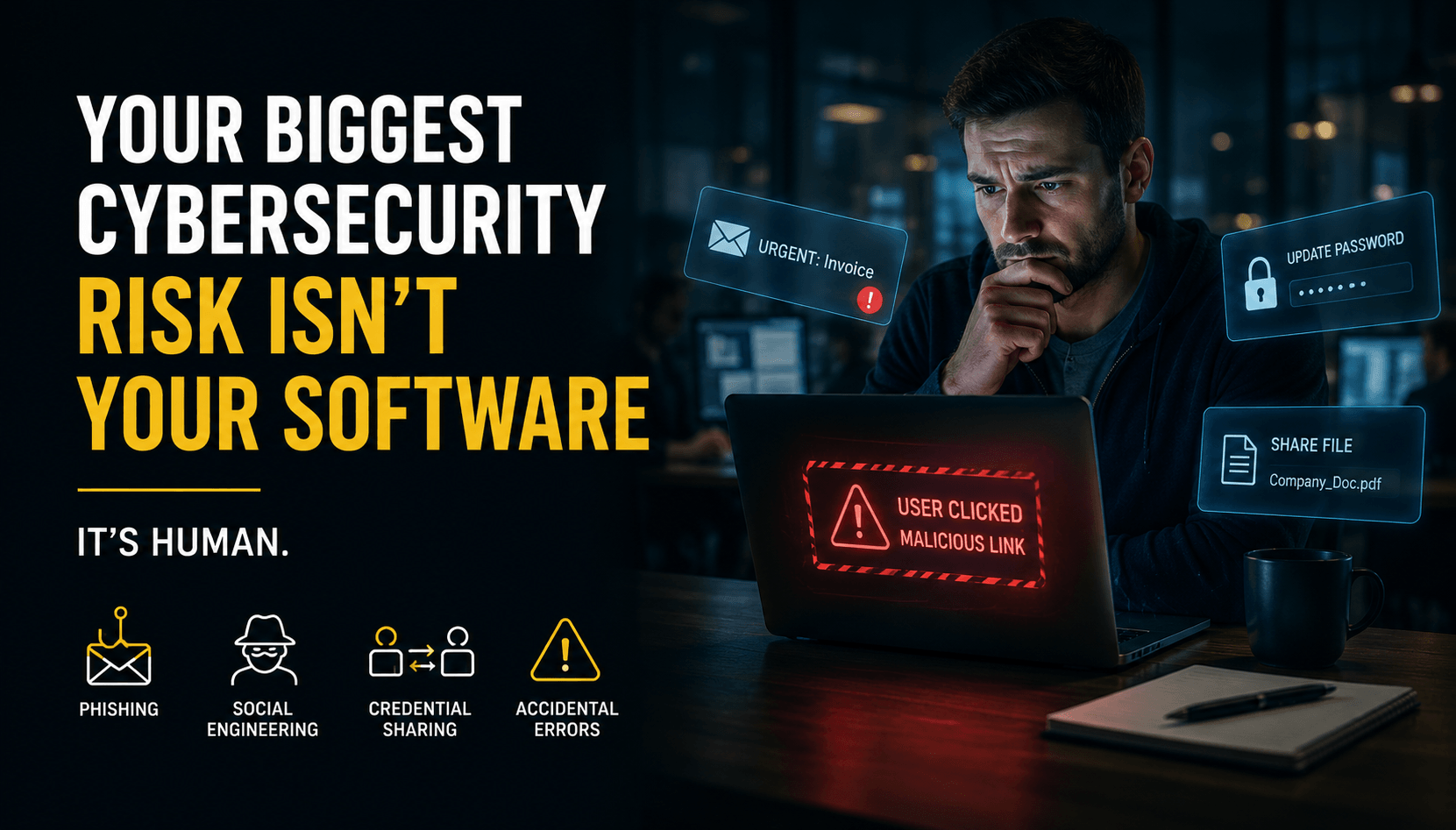
When most business owners think about cybersecurity, they picture technology — firewalls, antivirus, some blinking box in a server closet doing its job. So it comes as a genuine surprise to learn where the overwhelming majority of breaches actually begin: not with a hacker defeating your software, but with an ordinary employee clicking a link, opening an attachment, or wiring money because an email told them to.
The uncomfortable reality is that the strongest lock in the world doesn't help if someone inside opens the door. And in most businesses, that door gets opened not out of carelessness, but because the request looked completely normal.
Why attackers target people, not machines
Breaking through good security software is hard, expensive work. Tricking a busy person is cheap and reliable. So that's what attackers do. They've largely stopped trying to smash through the technology and instead go straight for the human sitting in front of it.
Their methods are convincing precisely because they don't look like attacks. They look like a routine Tuesday:
- An email that appears to come from you, the owner, asking an employee to buy gift cards or move a payment — urgently, quietly, "I'm in a meeting, just handle it."
- A message that looks exactly like a Microsoft 365 login page, asking someone to "re-verify" their password — which hands their credentials straight to an attacker.
- A fake invoice from a vendor you actually use, with the bank details quietly changed.
- A friendly phone call from "IT support" walking an employee through giving up access.
None of these require any technical skill to fall for. They require only a normal, trusting person having a busy day. That's the entire point.
Why this is actually good news
Here's the part that should encourage you: if your people are the primary way attackers get in, then your people are also your most powerful defense — and unlike a lot of security, this one doesn't require a big budget to fix.
A well-trained team is like a building full of alert employees. The attacker's whole strategy depends on the request looking normal and nobody questioning it. The moment your staff can recognize the patterns — the false urgency, the unexpected payment request, the login page that's almost right — the attack falls apart. You've turned every inbox in your company from a vulnerability into a tripwire.
Security professionals have a name for this: the human firewall. It's the layer of defense made not of software, but of people who know what to look for.
How to build a human firewall
Turning your team into an asset instead of a liability is more about consistency than intensity. The businesses that get this right tend to do a few simple things:
- Train regularly, not once. A single seminar during onboarding fades fast. Short, ongoing reminders keep awareness fresh, because the threats keep evolving.
- Practice with simulated phishing. Sending your own team safe, fake phishing emails — and coaching whoever clicks, without blame — is remarkably effective. People remember the lesson far better after nearly falling for it in a safe setting.
- Make it safe to ask and to report. The most dangerous four words in security are "I didn't want to bother anyone." If an employee who clicked something is afraid to speak up, a small mistake becomes a large breach. Reward the person who raises their hand.
- Set simple verification rules. A standing rule that any request to move money or change payment details must be confirmed by a second method — a phone call, in person — defeats a huge share of these scams on its own.
Notice that most of this is culture and habit, not technology. That's what makes it so cost-effective. You're not buying a product; you're building a reflex.
The bottom line
You can invest in excellent security tools — and you should. But if you stop there, you've locked every window and left the front door staffed by people who were never told what a burglar looks like. Technology and people aren't competing priorities. They're two halves of the same defense, and most businesses have spent on one and ignored the other.
The good news is that closing that gap is one of the highest-return moves in all of cybersecurity: relatively low cost, and it neutralizes the very attacks most likely to hit you.
Want to see how your team would hold up against a real-world phishing attempt — and turn them into your strongest layer of defense? Book a call with CyberTech and we'll help you build a human firewall that actually holds.
Questions about your own setup?
Talk to a real CyberTech engineer — no call center, no obligation.