Before You Roll Out AI, Read This: The Hidden Risks That Can Cost More Than You'll Ever Save
AI can make your Jacksonville business faster and leaner — but rushing it in without a security risk assessment can expose your data, break your compliance, and cost far more than it saves. Here's what to check first.
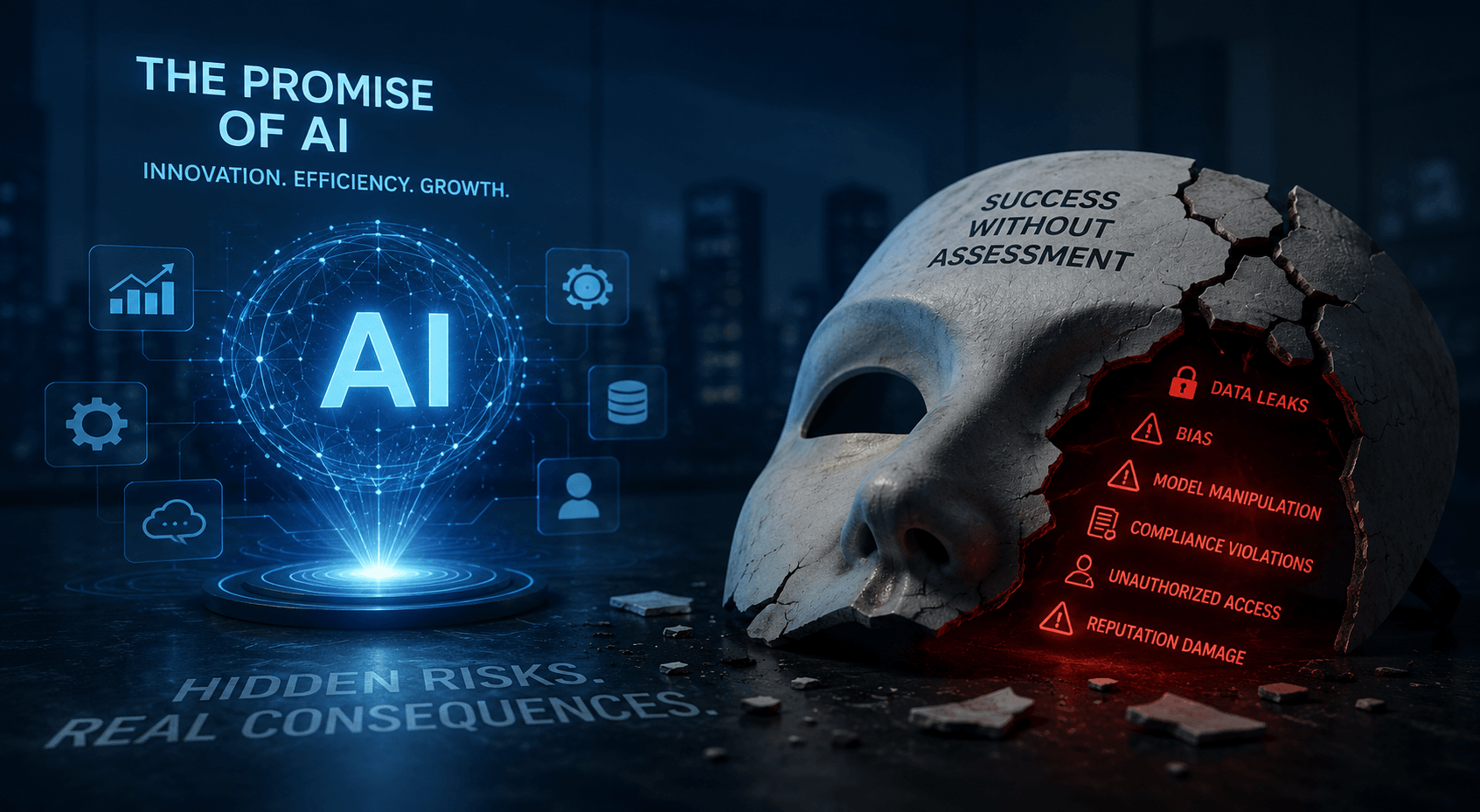
There's a quiet pressure in almost every business owner's inbox right now: everyone else is using AI, so we'd better catch up. Your competitors are talking about it. Your team is already pasting things into ChatGPT. A vendor is promising an AI tool that will cut your costs in half. The excitement is real, and honestly, a lot of it is justified — AI genuinely can make a small business faster and leaner.
But here's the part nobody selling you AI tends to mention: the fastest way to turn a productivity win into a very expensive loss is to roll AI out before you understand what it touches. The tools are easy to adopt. The risks are easy to miss. And the gap between those two is exactly where businesses get hurt.
Why the rush is the real danger
Most AI mistakes don't come from bad technology. They come from good technology adopted too fast, by well-meaning people, without anyone asking a simple question first: what happens to our information once it goes into this?
When a team is under pressure to "do something with AI," tools get adopted from the bottom up. An employee signs up for a free AI app to summarize contracts. A manager connects an AI assistant to the company email to save time. Nobody's acting maliciously — they're being resourceful. But each of those quiet decisions can quietly hand your business's information to a system you don't control and can't audit.
The risks that actually cost money
Let's talk plainly about where the losses come from.
Data exposure. Many AI tools learn from, store, or process whatever you feed them. Paste a client list, a financial statement, or a patient record into the wrong tool, and you may have just shared confidential data with an outside company — permanently, and outside your control. You can't un-send information.
Compliance violations. If you're in healthcare, finance, law, or you handle customer payment data, you operate under rules — HIPAA, PCI, and others — about where sensitive data can go. An AI tool that hasn't been vetted can put you out of compliance the moment an employee uses it, whether or not there's ever a breach. Regulators don't grade on good intentions.
Third-party vulnerabilities. Every AI tool you connect is a new door into your business. When you link an AI assistant to your email, files, or customer records, you're trusting that vendor's security as if it were your own — because now it effectively is. If they get breached, so do you.
Bad decisions made confidently. AI can be confidently wrong. A business that leans on AI output for quotes, contracts, or advice without a human check can ship errors at scale — and "the AI told us to" is not a defense your customers or your insurer will accept.
Why the losses outweigh the savings
Here's the math that matters. AI might save you a few hours a week, or trim a line item on your budget. Those are real gains, and they're worth pursuing.
But weigh them against the other side of the ledger. The average data breach costs a small or mid-sized business well into six figures once you add up recovery, legal fees, notification requirements, lost customers, and downtime. A single compliance violation can bring fines that dwarf a year of the "savings" the tool provided. And the reputational hit — the client who leaves because their information ended up somewhere it shouldn't — doesn't show up on a spreadsheet, but it's often the most expensive part of all.
The point isn't that AI is dangerous and you should avoid it. The point is that the upside is measured in hours and the downside is measured in the survival of the business. When the stakes are that lopsided, "let's just try it and see" is not a strategy.
What to do instead: assess before you adopt
None of this means slowing down for its own sake. It means putting one step before adoption: a security risk assessment. In plain terms, that's answering a handful of questions before a tool touches your business —
- What data will this tool see, and is any of it sensitive or regulated?
- Where does that data go, who else can access it, and is it used to train someone else's system?
- Does using it keep us compliant with the rules we operate under?
- If this vendor were breached tomorrow, what of ours would be exposed?
- Who on our team is allowed to use it, and for what?
Answer those first, and you get the best of both worlds: the speed and savings of AI, without betting the business on a tool nobody vetted.
Move fast — but not blind
AI is going to be part of how you run your business. That's not in question. The only question is whether you adopt it deliberately or accidentally. The businesses that win with AI won't be the ones that adopted it fastest — they'll be the ones that adopted it safely, so their gains actually stick.
Before you or your team roll out the next AI tool, have a cybersecurity professional walk through it with you first. A short conversation now is a lot cheaper than a breach later. Book a discovery call with CyberTech and we'll help you put AI to work — without putting your business at risk.
Questions about your own setup?
Talk to a real CyberTech engineer — no call center, no obligation.